


Garmin, from a GPS prototype to a sports companion: portrait of a brand
Founded in 1989 by two aviation engineers, Garmin put GPS in your pocket, then on your wrist. Thirty-seven years on, the brand spans sport, outdoor, marine, aviation and automotive.

Garmin takes its name from its two founders: Gary Burrell and Min Kao, two engineers from aircraft and marine navigation who, in 1989, bet that a military technology, GPS, would end up in everyone’s pocket. Thirty-seven years later, the brand employs more than 22,000 people in 37 countries, and the watch you spot on the trail or at the start of a marathon often carries its name. Here is where it comes from, what it makes, and how it goes about it.
Two engineers and a prototype
It starts in 1989 with a small team of engineers brought together by Gary Burrell and Min Kao to design a first GPS receiver prototype. The company sets up in Lenexa, Kansas, before moving to Olathe, in the same area, where its operational headquarters still stand. By 1990 it opens its first manufacturing site in New Taipei, Taiwan, with a dozen employees.
The first product arrives in 1991: the GPS 100, a portable navigation device built to serve on land, at sea and in the air. According to the brand, it was the first of its kind for consumers, and it found buyers straight away. The pattern is set: one know-how, adapted to very different uses.
From the cockpit to the wrist
Aviation comes first. In 1994, Garmin introduces the GPS 155, the first GPS receiver certified by the US aviation authority, letting a pilot fly on instruments from take-off to landing. In 1998 comes the GNS 430, which brings navigation, mapping and communications together on a colour screen.
Sport arrives in 2003 with the Forerunner 201, presented by the brand as the world’s first GPS running watch. Then cycling in 2006, with the Edge 205 and 305 bike computers, and consumer cars in 2005, with the compact nüvi navigator. In 2012, the fēnix opens the line of GPS adventure watches, built for the outdoors. The brand then moves into golf, diving, fishing and archery, each time with a device that carries GPS into a new activity.
Five markets, one thread
Today Garmin operates in five markets: fitness, outdoor, aviation, marine and automotive equipment supplied to carmakers. The brand itself says these markets are very different, but that their customers share the same passions: exploration, adventure and wellbeing.
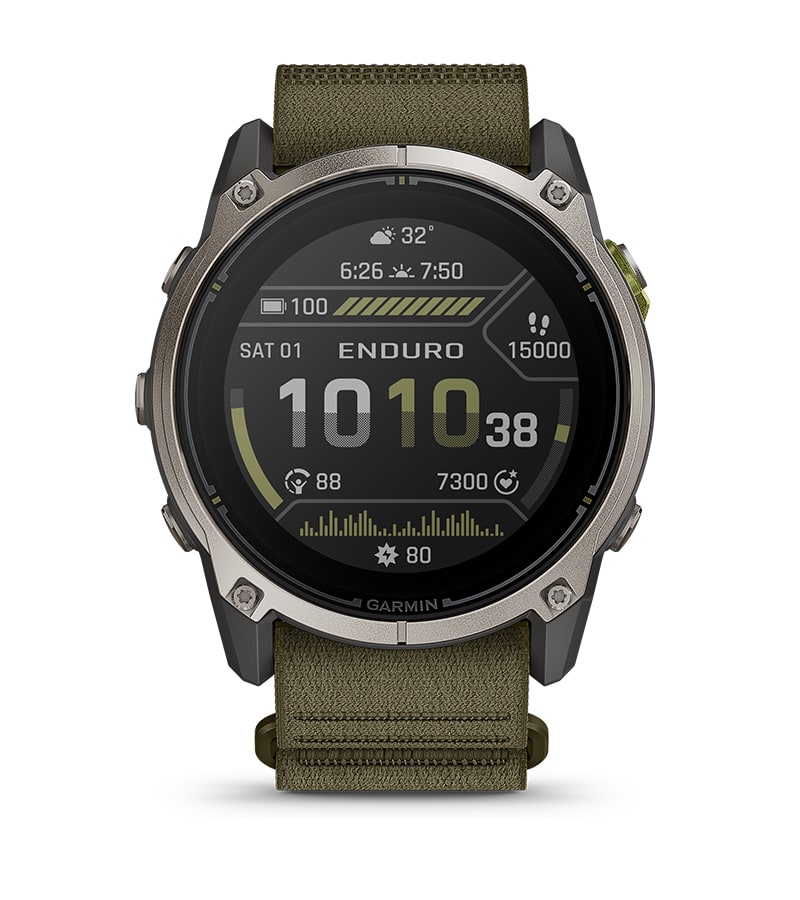
For O!mag readers, it is the watch family that matters most: the Forerunner for running, the fēnix and the Enduro for the mountains and long days out, the vívofit, which transformed the activity-tracker market in 2014 with more than a year of battery life. The Enduro 4, which the magazine has covered, is the latest in that line.
Making it all in-house
Garmin describes itself as “vertically integrated”: design, manufacturing, distribution, sales and support happen in its own centres, in the United States, Europe and Asia. According to the brand, this is what lets it hold a high level of quality while responding quickly when the market shifts. From first concept to mass production, the product never leaves the house.
The brand also puts its values in writing: honesty, integrity, respect for associates, customers and partners. Its mission, it says, is to be an enduring company by creating products that become an essential part of its customers’ lives. Those are its words; the devices are judged in use.

Right now
The last few years show where the brand is heading. In 2023 it introduced an electrocardiogram app cleared by the US health authority, to look for signs of atrial fibrillation at the wrist. In 2024, fēnix 7 watches were used to collect biometric data during the Polaris Dawn space mission. In 2025, the fēnix 8 Pro series became, according to Garmin, its first smartwatch to carry inReach technology, the satellite messaging that joined Garmin with the acquisition of DeLorme in 2016, and the first with a MicroLED display.
The sports watch is becoming a tool for health and safety, a long way from the plain GPS stopwatch of the early days. That is the shift the Enduro 4 illustrates, with its solar charging and built-in maps.
And for you, in Switzerland
Garmin is well established here: its Swiss website and online shop are run by Garmin Switzerland Distribution GmbH, a company based in Schaffhausen, on Mühlentalstrasse. Support answers in German and French, by phone or contact form. So you buy from a Swiss subsidiary, and it is the one you turn to with a question about your watch, not Olathe.
Why we like it
We like a brand whose name is a blend of its two founders' first names, and whose first product, in 1991, already worked on land, at sea and in the air. We also like that it still makes what it sells itself, from design to warehouse.
Exactly the kind of brand we’d love to come across on O!deal one day.
Garmin products we’ve spotted
1

Garmin Enduro 4: a GPS watch that runs on sunlight
The Garmin Enduro 4 combines a titanium bezel, Power Sapphire lens, preloaded topographic maps and solar charging. In expedition mode, battery life becomes unlimited with solar charging.