

Exquis Pure: a hexagonal MIDI controller for expressive playing
Exquis Pure is an MPE controller with a 61-key hexagonal grid, CV outputs for modular gear, and a built-in looper. Designed and assembled in France.
What it is
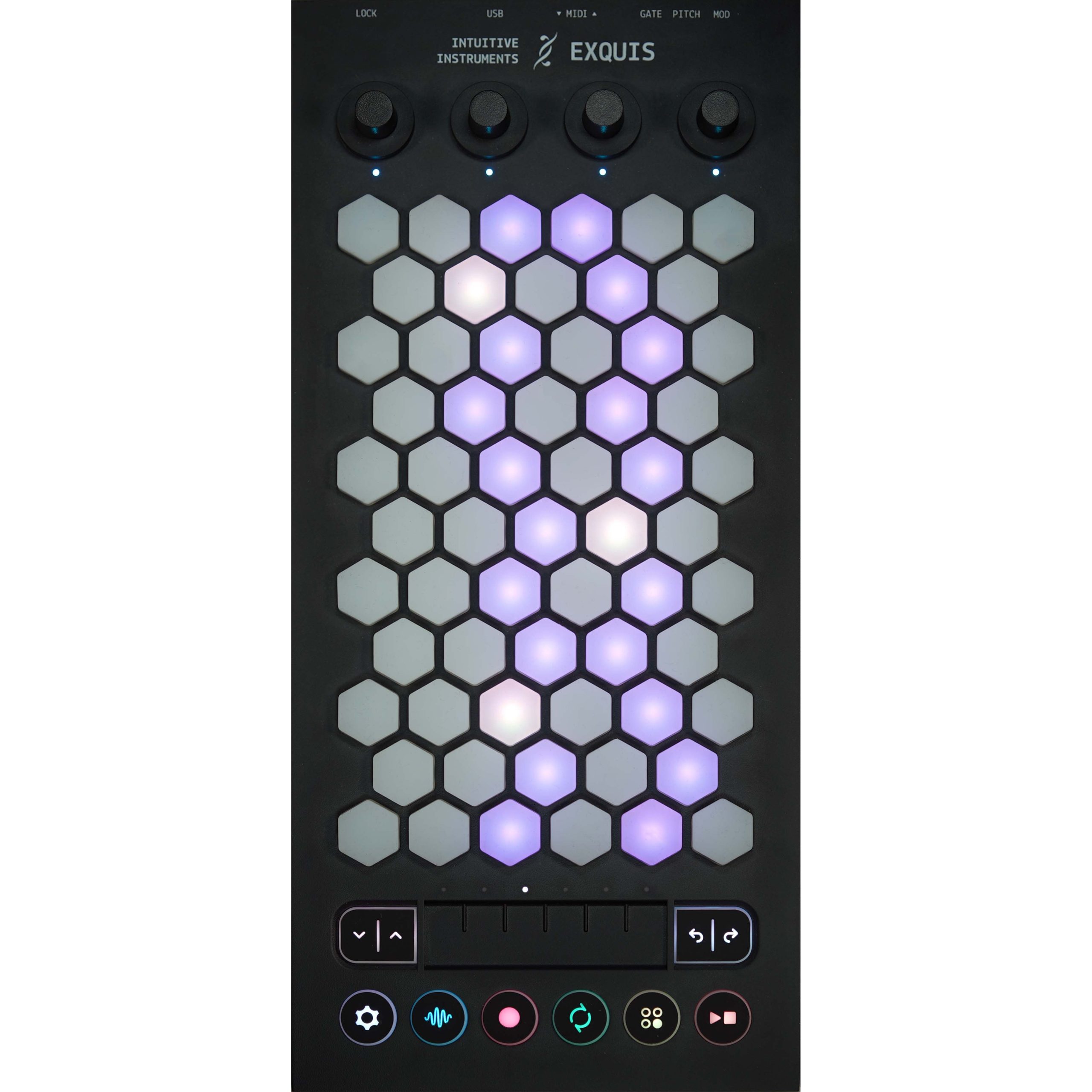
The Exquis Pure is a MIDI controller built around MPE, the protocol that lets a single key carry pitch bend, pressure and slide as separate expressive dimensions. Instead of the usual rectangular piano layout, its 61 keys are arranged in a hexagonal grid, a shape chosen to let notes sit in more than one direction relative to each other. Around the keybed sit four clickable encoders, ten push buttons and a six-zone capacitive slider, all with RGB backlighting. It is aimed at people who want to play or programme software instruments, MIDI synthesizers and modular synthesizer setups from one surface, whether at a desk or on a small stage. The unit is designed and assembled in France.
Why it exists
According to the brand, most controllers separate the tasks of playing notes, shaping sound and sequencing ideas across several boxes. Intuitive Instruments describes the Exquis Pure as an attempt to fold those tasks into one intuitive and expressive surface, one that can address software, MIDI synths and modular gear without swapping controllers depending on the studio setup.
What matters
The 61-key hexagonal layout is the first thing anyone touches. Because keys are packed in a honeycomb rather than a straight row, the same musical interval can appear in several directions from any given key, which changes how scales and chords are found by hand rather than by reading. For someone moving between styles or tunings, that grid changes the physical habit of playing, not just the look of the surface.
MPE support is what turns the keybed from a switch-based trigger into something closer to a continuous instrument. Each key can transmit its own pitch, pressure and movement independently, so a chord played on the Exquis Pure can have each note bend, swell or fade on its own rather than all together. That matters most for anyone using expressive software instruments or MPE-aware synthesizers, where a static keypress would otherwise flatten the performance.
The CV Pitch, CV Mod and CV Gate outputs, each running 0 to 5V at up to 20mA, are what let the Exquis Pure step outside the computer entirely. These are the same voltage ranges used across a lot of modular synthesizer gear, so the controller can send pitch, modulation and gate signals directly into a modular rack, sitting alongside patch cables rather than requiring a separate MIDI-to-CV converter.
The built-in looper holds eleven tracks with four loops each, and the sequencer chains up to eleven events. Together they mean sketches, layered loops or short sequences can be built and played back from the controller itself, before or without opening a laptop, which changes how quickly an idea can be tried out compared with routing everything through software first.
Power draw sits at a maximum of 4.5W over USB-C 3.0, drawing up to 0.9A at 5V. That is a modest budget, which matters for anyone running the Exquis Pure from a laptop’s USB port, a USB hub, or a bus-powered interface without needing a separate power supply.
Day to day
The Exquis Pure connects to a computer over USB-C, which also carries its power. On the software side, it needs macOS 10.11 or later, or Windows 10 or later, to run the Exquis app that comes with the unit, along with a set of free plug-ins and presets in VST, VST3 and AU formats for use inside a digital audio workstation. For hardware setups, MIDI In and Out run through 3.5mm stereo minijack connectors rather than the traditional five-pin sockets, so a matching cable or adaptor is part of connecting to other MIDI gear. The CV outputs use the same 3.5mm-style connections at modular-compatible voltage and impedance, letting the controller sit directly in a patch alongside eurorack modules. At 32 × 15 × 4 cm (12.5 × 5.8 × 1.4 in) and 1 kg (1.15 lbs), it is light and flat enough to travel in a bag alongside a laptop.
Technical specifications
| Feature | Value |
|---|---|
| Type | MIDI controller (MPE) |
| Design and assembly | France |
| Keybed | 61 hexagonal keys |
| Encoders | 4 clickable encoders with RGB backlighting |
| Buttons | 10 push buttons with RGB backlighting |
| Slider | 6-zone capacitive slider with RGB backlighting |
| USB port | USB-C, USB 3.0, 5V, 0.9A max, 4.5W max consumption |
| MIDI In/Out | 3.5mm stereo minijack, 5V, 5mA max |
| CV Pitch and CV Mod | 0 to 5V, 20mA max, 1kΩ impedance |
| CV Gate | 0 or 5V, 20mA max, 1kΩ impedance |
| Software requirements | macOS 10.11 or later / Windows 10 or later |
| Supported plug-in formats | VST / VST3 / AU |
| Looper | 11 tracks, 4 loops per track |
| Sequencer | 11 chainable events |
| Dimensions | 32 × 15 × 4 cm (12.5 × 5.8 × 1.4 in) |
| Weight | 1 kg (1.15 lbs) |
| Included software | Exquis app (Windows/macOS) and free plug-ins/presets |
What the brand says
Intuitive Instruments describes the Exquis Pure as an intuitive and expressive MIDI controller, built to play software instruments, MIDI synthesizers and modular synthesizers from a single surface.
Why it caught our eye
We're drawn to the hexagonal grid and MPE support together — it's a rare combination that changes how notes are found and played, not just how they're triggered. We also like that it speaks CV natively, so it can sit in a modular rack as easily as on a laptop. And having a looper and sequencer built into the controller itself, rather than tucked away in software, feels like a genuine nod to playing ideas out loud.
Exactly the kind of brand we’d love to come across on O!deal one day.

More from Intuitive Instruments
2
- O!radarIntuitive Instruments
dualo du-touch S: a keyboard, sampler and looper packed into one small case
The dualo du-touch S combines a velocity-sensitive keyboard, a built-in sampler and a live looper in a 0.6 kg case, with four selectable note layouts and up to 18 loops per track.
- O!radarIntuitive Instruments
Exquis Deluxe: Intuitive Instruments' hexagonal MIDI controller made in France
A 61-key hexagonal MIDI controller with pressure- and position-sensitive keys, built and assembled in France by Intuitive Instruments, with a built-in looper and sequencer.

Also worth reading
- O!radarAeroband
Aeroband Guitar: the portable digital guitar that fits in a bag
A detachable, battery-powered guitar with silicone strings and a built-in speaker — Aeroband wants beginners to play from day one, wherever they are.
- O!radarBose
Bose Noise Cancelling Wired Earbuds: wired is back, and better
Noise-cancelling wired earbuds with a direct USB-C connection, four microphones for QuietControl technology, and a choice of three listening modes.
- O!radariKier
iKier Flex: the compact laser engraver that folds in on itself
A fully enclosed desktop laser engraver, delivered pre-assembled, able to work wood, leather or dark acrylic without taking over a whole workshop.